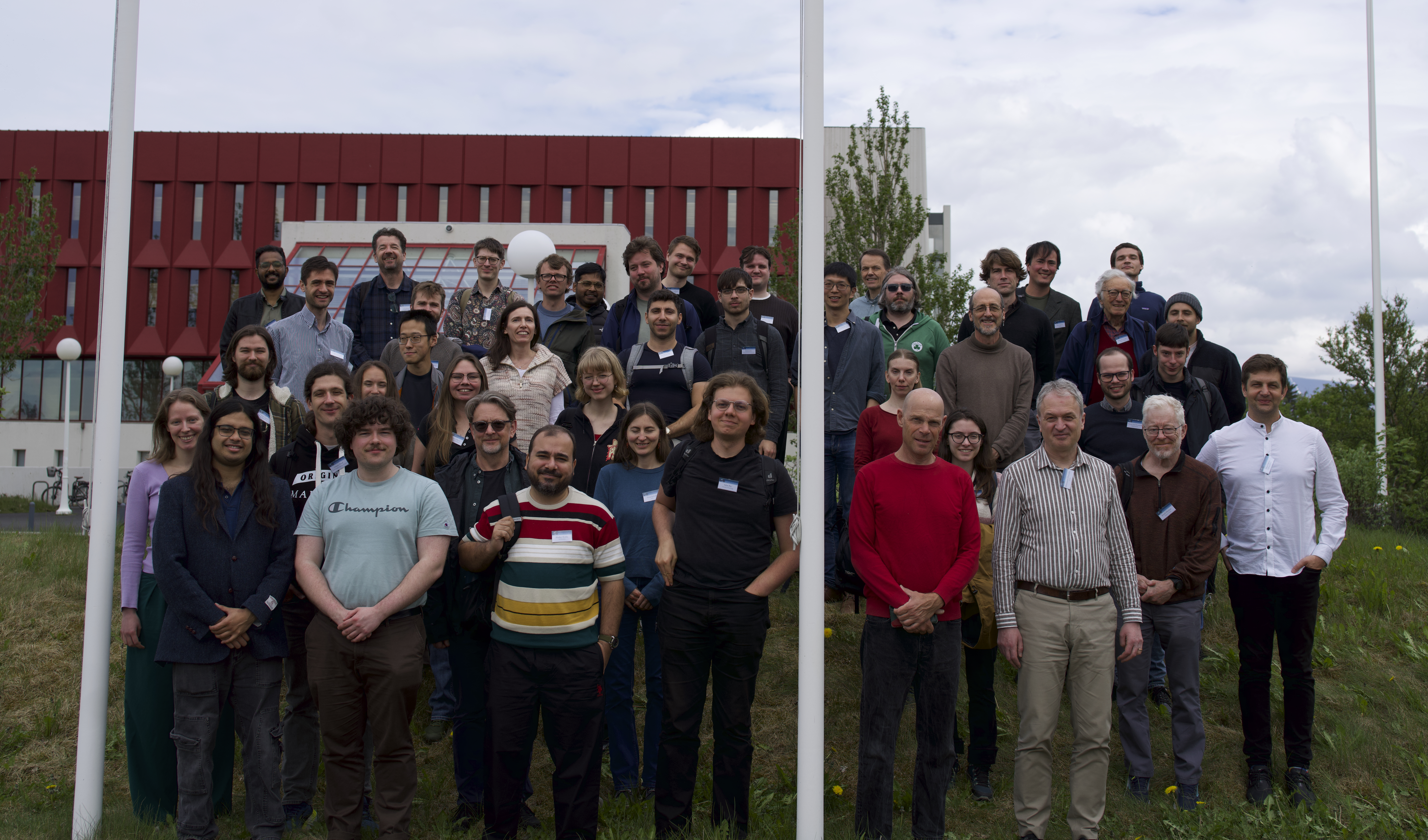
34th Nordic Network Meeting on "Strings, Fields and Branes"

Atlantic/Reykjavik
E-103 (Edda)

E-103

Edda

Arngrímsgata 5, 107 Reykjavík, Iceland
Alexia Nix (University of Iceland), Evangelos Tsolakidis (University of Iceland), Lárus Thorlacius (University of Iceland), Matthew M Roberts (Science Institute, University of Iceland), Matthias Harksen, Valentina Giangreco Puletti, Vyshnav Mohan
Description

Welcome

We are delighted to announce the 34th Nordic Network Meeting on "Strings, Fields and Branes", for the first time taking place in Reykjavík during 1–3 June 2026. Over three days this regional gathering will bring together established researchers, early-career scientists and (PhD) students to exchange ideas across string theory, quantum field theory and related topics, fostering this way new collaborations. It will also feature three pedagogical lectures that will be given by leading experts of the field.

This year's event is organized by the high energy theory group of the University. (logo made by Matt)

Venue

All talks and coffee breaks will take place in Edda, lecture hall E-103. The street address is Arngrímsgata 5, 107 Reykjavík, Iceland. Here's a map of the campus.

Scientific Programme

The lectures will be given by

  • Fiona Seibold (Ecole Polytechnique, Lausanne)
  • Roberto Emparan (University of Barcelona)
  • Sean Hartnoll (University of Cambridge)

The contributed talks will be given by

  • Adi Armoni (Swansea University)
  • Ayan Kumar Patra (Durham University)
  • Bhasker Shukla (NIT Rourkela)
  • Charles Thull (City St George's, University of London)
  • Elisa Iris Marieni (University of Southampton)
  • Emil Have (University of Oxford and Niels Bohr Institute)
  • Ingrid Vazquez-Holm (Uppsala University and Nordita)
  • Jesse van Muiden (Imperial College London)
  • Jury Radkovski (Perimeter Institute)
  • Mihailo Čubrović (Institute of Physics Belgrade)
  • Rahul Poddar (University of North Florida)
  • Ronnie Rodgers (Nordita)
  • Troels Harmark (Niels Bohr Institute)
  • Victoria Martin (University of North Florida)
  • Vincent Van Hemelryck (Uppsala University)
  • Watse Sybesma (Nordita)
  • Ziqi Yan (Niels Bohr Institute)

On the first day of the conference, a string theory colloquium will be given by Paolo Di Vecchia. 

Reception and Dinner

After the final talk of the first day, a reception will be held at (TBA). The conference dinner will take place on the evening (18:30) of June 2nd at Kopar. It is located at Geirsgata 3, 101 Reykjavík, Iceland, only 20 minutes away on foot from the conference hall. 

Accommodation and Transportation

The largest airport in the country (Keflavík International Airport) is located approximately fifty kilometers southwest of Reykjavík and commuting from and to the city is usually done via bus, taxi, or a rental. For the first (and more economical) option there are only two choices, either bus lane # 55 departing from here where one can pay directly via card (Visa, Mastercard, Europay) on the bus, or Flybus (tickets can be bought at the airport as well) departing from here

The venue that will host the conference is centrally located and well connected via Strætó ( S ) bus lanes # ( 1  2  3  6  11 ,  12 ), [ 13 ,  15 ], { 5  8 14 } (listed in ascending distance order from nearest bus stop; (~ 5 mins), [~ 10 mins], {~ 20 mins}; pace: running duck). A map of all bus routes in the city can be found here and the mobile app for purchasing tickets valid only within the city is Klappið. Paying by card is also possible (Visa, Mastercard, Europay) and there is a day/week cap (3/9 single adult tickets) –which will also be valid via the app– only if you use the same card for all transactions. Since there are only single, monthly and yearly bus tickets, you may alternatively consider purchasing the Reykjavík City Card, which includes unlimited access to all city buses for up to three days. 

We strongly recommend all participants that will arrange their own accommodation to book something well in advance, as June is a popular month for tourism in Iceland and prices can very easily exceed the already inflated market values. We have reserved a limited number of rooms at the Studenthostel, which is a five minute walk from the location of the event. Please indicate during your registration if you'd like for us to book one on your behalf. 

To-do in Iceland

There are many hiking and geothermal areas in the country so a swimsuit, hiking shoes and waterproof clothes would be essential items.

Participants
    • 1
      Registration E-103

      E-103

      Edda

      Arngrímsgata 5, 107 Reykjavík, Iceland
    • 09:50
      Welcome E-103

      E-103

      Edda

      Arngrímsgata 5, 107 Reykjavík, Iceland
    • 2
      Integrable deformations of AdS3 strings E-103

      E-103

      Edda

      Arngrímsgata 5, 107 Reykjavík, Iceland

      Free strings on AdS$_{3}\times$ S$^{3}\times$ T$^{4}$ and AdS$_{3}\times$ S$^{3}\times$ S$^{3}\times$ S$^{1}$ can be described by integrable string sigma models and admit a very rich landscape of integrable deformations. In this talk I will focus on TsT, trigonometric and elliptic deformations which preserve some amount of supersymmetry and interpolate between well-known integrable setups. I will present the deformed geometries and show that the S-matrix encoding the scattering of excitations on the string worldsheet is compatible with integrability.

      Speaker: Fiona Seibold (EPFL)
    • 11:00
      Break E-103

      E-103

      Edda

      Arngrímsgata 5, 107 Reykjavík, Iceland
    • 3
      Short strings from AdS3 integrability E-103

      E-103

      Edda

      Arngrímsgata 5, 107 Reykjavík, Iceland

      I will present new numerical solutions to the Quantum Spectral Curve for AdS3xS3xT4 at pure RR-flux spanning for the first time from weak to strong coupling. At strong coupling this spectrum organises into string mass-levels with Kaluza-Klein fine-splitting at subleading order. I will discuss how these results match against classical folded string solutions in curved AdS space up to quantum corrections. Based on arXiv:2601.21992.

      Speaker: Charles Thull (City St George's, University of London)
    • 4
      Tropicalized sine-Gordon model E-103

      E-103

      Edda

      Arngrímsgata 5, 107 Reykjavík, Iceland

      I will introduce a particular zero-dimensional limit of quantum field theories -- Tropicalization (Borinsky, 2508.14263). The 4d scalar field theory with quartic interaction and 2d Sine-Gordon will be taken as two primary examples. The tropical limit is conjectured to preserve quantitatively and qualitatively certain properties of a given QFT. The main focus of the talk will be on using the Sine-Gordon model as a toy model for exploring the connection between the RG structure of the theory and its tropicalized counterpart. I will describe the results obtained so far and discuss further directions. (Work In Progress with R. Bittleston, M. Borinsky and S.R. Kannagi).

      Speaker: Jury Radkovski (Perimeter Institute, McMaster University)
    • 12:10
      Lunch
    • 5
      Deformations at higher genus by coupling to moduli curvature E-103

      E-103

      Edda

      Arngrímsgata 5, 107 Reykjavík, Iceland

      $T\bar T$ deformations have been widely studied for 2d CFTs on the plane and the torus, and have many interesting implications for two and three dimensional quantum gravity. However, these deformations have not yet been extended to higher genus. Using ideas initiated by Friedan and Shenker in the 80s, we formulate the $T\bar T$ operator in terms of the Kähler form on the moduli space of higher genus Riemann surfaces, which provides a very natural interpretation of the solvability of such deformations and extends the deformation to arbitrary genus. We then explore what properties of the CFT partition function survive and what are modified by the deformation, for example factorization at degeneration limits. Finally we discuss how this formalism suggests how to reconstruct a bulk AdS$_3$ spacetime with a higher genus boundary.

      Speaker: Rahul Poddar (University of North Florida)
    • 6
      Worldsheet Theory for Two Dimensional QCD E-103

      E-103

      Edda

      Arngrímsgata 5, 107 Reykjavík, Iceland

      Large-N two dimensional QCD was solved 50 years ago by 't Hooft.
      The model is an example of confinement and chiral symmetry breaking and it resembles real world QCD.
      Yet, despite of several efforts the string dual of the model is not known.
      In this talk I will present a worldline derivation of the solution of 2d QCD and a preliminary results about the worldsheet theory of the dual string.
      This work is done in collaboration with Shigeki Sugimoto.

      Speaker: Adi Armoni (Swansea University)
    • 7
      Interplay of magnetic field and chemical potential induced anisotropy and frame dependent chaos of a qq pair in holographic QCD E-103

      E-103

      Edda

      Arngrímsgata 5, 107 Reykjavík, Iceland

      We investigate the role of both magnetic field and chemical potential on the emergence of chaotic dynamics in the quantum chromodynamics (QCD) confining string from the holographic principle. An earlier developed bottom-up model of Einstein-Maxwell-dilaton gravity, which mimics QCD features quite well, is used. The qualitative information about the chaos is obtained using the Poincaré sections and Lyapunov exponents. We find signatures of chaos in energetically disfavored string configurations, that are closer to the horizon, whereas no chaos is observed in energetically favored string configurations that are away from the horizon. Our results depend quite strongly on the frame we consider in the analysis. In the string frame, the chemical potential and the magnetic field suppress the chaotic dynamics in both parallel and perpendicular orientations of the string with respect to the magnetic field. Meanwhile, in the Einstein frame, the magnetic field suppresses/enhances the chaotic dynamics when the string is orientated perpendicular/parallel to the magnetic field, while the chemical potential enhances the chaotic dynamics for both orientations. The reported Lyapunov exponents are consistent with a classical analogue of the Maldacena-Shenker-Stanford bound in the parameter space of the model and we find it to be always satisfied in both frames.

      Speaker: Bhasker Shukla (NIT Rourkela)
    • 14:40
      Break E-103

      E-103

      Edda

      Arngrímsgata 5, 107 Reykjavík, Iceland
    • 8
      Holomorphic D-branes E-103

      E-103

      Edda

      Arngrímsgata 5, 107 Reykjavík, Iceland

      I will discuss various examples of D-brane embeddings in supergravity backgrounds, specified by a holomorphic function of a complex coordinate on the D-brane’s worldvolume. These embeddings have energy that saturates a BPS bound and they preserve a fraction of supersymmetry. I will pay particular attention to embeddings in AdS5 x S5, where through holography they provide analytically tractable examples of strongly coupled quantum field theories without translational invariance.

      Speaker: Ronnie Rodgers (Nordita)
    • 9
      Amplitudes for gravitational radiation E-103

      E-103

      Edda

      Arngrímsgata 5, 107 Reykjavík, Iceland

      I will talk about the path from quantum scattering amplitudes to observables for gravitational radiation from binary inspirals. We can extract classical physics from quantum scattering, which we obtain by using the double copy property to get gravitational amplitudes from gauge theory. There are challenges on every level, including removing unwanted states from the double copy, and we extend these methods to loop amplitudes.

      Speaker: Ingrid Vazquez-Holm (Uppsala University and Nordita)
    • 15:50
      Break E-103

      E-103

      Edda

      Arngrímsgata 5, 107 Reykjavík, Iceland
    • 10
      TBA E-103

      E-103

      Edda

      Arngrímsgata 5, 107 Reykjavík, Iceland
      Speaker: Paolo Di Vecchia (Nordita)
    • 18:00
      Reception TBA

      TBA

      TBA
    • 11
      Cosmological singularities, quantum chaos and prime numbers E-103

      E-103

      Edda

      Arngrímsgata 5, 107 Reykjavík, Iceland

      At a singularity the continuum description of spacetime breaks down and one can hope that the microscopic constituents will be revealed. Over 50 years ago, Belinski-Khalatnikov-Lifshitz (BKL) argued that the dynamics of spacetime close to the Big Bang singularity (or inside black holes) is chaotic and inhomogeneous. I will revisit the BKL scenario within a modern understanding of quantum chaos and holographic duality. I will argue that the remarkable modular symmetries that arise in the near-singularity dynamics suggests a dual description of the start of time as a so-called “primon gas”, a description that is at once both simple and also connects with deep results from number theory.

      Speaker: Sean Hartnoll (University of Cambridge)
    • 11:00
      Break E-103

      E-103

      Edda

      Arngrímsgata 5, 107 Reykjavík, Iceland
    • 12
      New Rotating Black Holes in String Theory E-103

      E-103

      Edda

      Arngrímsgata 5, 107 Reykjavík, Iceland

      I will present new rotating black hole solutions of the low-energy effective action of string theory. These geometries are asymptotically flat with a linear dilaton vacuum and exhibit unusual thermodynamic properties, including a mass-independent Hawking temperature and absence of a Kerr-like bound. Finally, I will show that these solutions arise from the large-d limit of Myers–Perry black holes. This talk is based on 2602.06905.

      Speaker: Watse Sybesma (Nordita)
    • 13
      Berry conjecture, BPS chaos, and ensemble averaging E-103

      E-103

      Edda

      Arngrímsgata 5, 107 Reykjavík, Iceland

      We consider the geodesics and the profiles of scalar normal and quasinormal modes in supergravity backgrounds with 1/2 BPS, 1/4 BPS and 1/16 BPS supersymmetry (bubbling geometries and D1-D5-P microstates and black holes). We show that the (quasi)normal modes show progressively stronger chaos in the sense of the Berry random wave conjecture as we reduce the supersymmetry and approach the black hole limit. We interpret this finding in the context of the recent works on BPS chaos in holographic CFTs. We further show how the dynamics of sets of geodesics also approaches the black hole behavior as we reduce supersymmetry. We comment the consequences of our findings for the idea of ensemble averaging in black hole solutions.

      Speaker: Mihailo Cubrovic (Institute of Physics Belgrade)
    • 12:10
      Lunch
    • 14
      The Wilson spool beyond Einstein gravity E-103

      E-103

      Edda

      Arngrímsgata 5, 107 Reykjavík, Iceland

      The Wilson spool is a gauge invariant object that harnesses the Chern-Simons formulation of 3D gravity to calculate quantum gravitational effects to all orders in Newton's constant. To date, the spool has only been formulated in the context of Einstein gravity. A natural extension is to compute the spool in the context of warped AdS3 black holes, since this spacetime also admits a Chern-Simons formulation, but is not a solution of Einstein gravity (but rather Lower-Spin Gravity or Topological Massive Gravity). We present the necessary changes to define a Wilson spool in this setting.

      Speaker: Victoria Martin (University of North Florida)
    • 15
      Holographic renormalisation at future null infinity E-103

      E-103

      Edda

      Arngrímsgata 5, 107 Reykjavík, Iceland

      I will discuss the construction of a boundary energy-momentum tensors for asymptotically flat spacetimes in 3 and 4 bulk spacetime dimensions. This is achieved by endowing future null infinity with the most general allowed Carrollian geometry and varying the on-shall gravitational action with respect to the Carrollian data. In particular, this requires us to develop a holographic renormalisation procedure for asymptotically flat spacetimes, which reveals that, in 4d, the shear is part of the boundary data on par with the Carrollian structure. The resulting energy-momentum-news complex obtained by variation obey a diffeomorphism Ward identity that is equivalent to the Bondi mass and angular momentum loss equations, while local Carroll boosts are anomalous in both 3 and 4 dimensions.

      Speaker: Emil Have (University of Oxford and Niels Bohr Institute)
    • 16
      Twisted BPS decoupling limits and AdS/CFT E-103

      E-103

      Edda

      Arngrímsgata 5, 107 Reykjavík, Iceland

      DLCQ limits are BPS decoupling limits that zoom in to the dynamics close to certain BPS momentum states.They are of immense importance in string and M-theory as they are related by U-duality to the AdS/CFT correspondence, matrix theories and non-relativistic string theory. In this talk we introduce twisted BPS decoupling limits for BPS states in curved backgrounds such as AdS$_5\times S^5$. Unlike DLCQ limits, they involve a BPS state corresponding to a momentum along a globally twisted fiber in a fiber bundle. Zooming in to string fluctuations above the BPS state reveals a non-relativistic sigma-model for which the emergent non-Lorentzian target space has a natural symplectic structure, in line with the recent realization that BPS decoupling limits are associated with non-Lorentzian geometry. Twisted BPS decoupling limits can be introduced for D-branes as well, probing a non-Lorentzian geometry that includes the same symplectic structure as the string. For AdS$_5 \times S^5$ in the global patch, these limits are dual to Spin Matrix theory limits of $\mathcal{N}=4$ super Yang-Mills theory.

      Speaker: Troels Harmark (Niels Bohr Institute)
    • 17
      Matrix Theory, String Worldsheet, and Supergravity E-103

      E-103

      Edda

      Arngrímsgata 5, 107 Reykjavík, Iceland

      Starting with the decoupling limits zooming on D-branes in string theory, whose near-BPS dynamics is captured by different matrix theories, I will focus on the associated string worldsheet dynamics and its connection to ambitwistor string theory in the chiral sector. I will argue how the dynamics of the target space supergravity theories, which are typically non-Lorentzian in the low-N regime, can arise from the string worldsheet theory.

      Speaker: Ziqi Yan (Niels Bohr Institute)
    • 15:00
      Break E-103

      E-103

      Edda

      Arngrímsgata 5, 107 Reykjavík, Iceland
    • 18
      4d N=4 string islands from asymmetric orbifolds E-103

      E-103

      Edda

      Arngrímsgata 5, 107 Reykjavík, Iceland

      String islands are isolated points in the space of string vacua that have no moduli except the dilaton, enjoy rank reduction and lead to consistent pure supergravity theories. Asymmetric orbifold constructions are powerful tools that enable us to access these points in the moduli space that are inaccessible to more standard string compactification techniques. In this talk, we classify all supersymmetry-breaking crystallographic SO(6) elements and use them to populate the landscape of type II vacua. To construct heterotic vacua, we take as orbifold actions automorphisms of the Leech lattice. In this landscape of 4d N=4 theories we identify many island candidates, explicitly construct some of them and show the appearance of archipelagos.

      Speaker: Elisa Iris Marieni (University of Southampton)
    • 19
      Testing a holographic constraint for scale separation in type II AdS3 compactifications E-103

      E-103

      Edda

      Arngrímsgata 5, 107 Reykjavík, Iceland

      Understanding whether string theory admits AdS vacua with scale separation, i.e. a large hierarchy between the cosmological constant and the Kaluza–Klein scale, remains a central challenge and source of debate in the field. In this context, holography could provide a powerful lens for assessing the consistency of such solutions. Yet, holographic duals to scale-separated vacua remain elusive. Motivated by the expectation that any putative dual must satisfy certain basic properties, recent work has proposed that scale-separated solutions whose mass spectra yield integer conformal dimensions must obey a non-trivial constraint on the cubic couplings of the theory. This criterion has been verified for the so-called DGKT solutions. In this talk, I will test this holographic constraint for a family of AdS$_3$ solutions that exhibit scale separation with an integral spectrum. These solutions arise from compactifications of type II string theory on $\mathbb{Z}_2^3$ orbifolds of twisted tori with $G_2$-structure. I will show that the holographic constraint is not satisfied in these cases, but that it is restored when considering non-abelian orbifolds containing a $\mathbb{Z}_2^3$-subgroup. I will also comment on the analogous situation for AdS$_4$ compactifications on $\mathbb{Z}_2^2$ orbifolds.

      Speaker: Vincent Van Hemelryck (Uppsala University)
    • 18:30
      Dinner Kopar

      Kopar

      Geirsgata 3, 101 Reykjavík, Iceland
    • 20
      TBA E-103

      E-103

      Edda

      Arngrímsgata 5, 107 Reykjavík, Iceland

      TBA

      Speaker: Roberto Emparan (ICREA & U Barcelona)
    • 11:00
      Break E-103

      E-103

      Edda

      Arngrímsgata 5, 107 Reykjavík, Iceland
    • 21
      Supersymmetric Branes in the M-theory Path Integral E-103

      E-103

      Edda

      Arngrímsgata 5, 107 Reykjavík, Iceland

      I will discuss recent progress toward a microscopic description of M-theory in holographic backgrounds based on supersymmetric M2-branes. In $AdS_4$ and $AdS_7$, these branes localize to tractable sectors, allowing direct computations of protected non-perturbative effects and refining the holographic dictionary. In particular, this perspective highlights the role of ensembles, suggesting that in $AdS_4$ the natural bulk description is related to a grand-canonical treatment of ABJM theory. Time permitting, I will also present ongoing work on M5-brane instantons and their role in M-theory partition functions.

      Speaker: Jesse van Muiden (Imperial College)
    • 22
      BKL dynamics and Trans-IR flows in AdS black holes E-103

      E-103

      Edda

      Arngrímsgata 5, 107 Reykjavík, Iceland

      Abstract: The interior of an asymptotically AdS black hole provides a natural setting in which one can extend the notion of holographic RG flows beyond their conventional infrared fixed points. In this talk, I will explain how these extended “trans-IR” flows offer a natural framework for capturing gravitational dynamics behind the horizon, especially in the approach to a spacelike singularity. Close to the singularity, the geometry enters a regime governed by the BKL conjecture and characterized by a sequence of Kasner epochs and eras. I will first show how mixmaster (chaotic) dynamics can be realized inside any higher-dimensional AdS black hole. I will then introduce a monotonic thermal a-function – derived from the null energy condition – which provides a measure of the effective degrees of freedom along the entire RG flow. Using this function, I will show that the complete sequence of Kasner epochs and eras can be effectively captured, with the degrees of freedom thinning out and ultimately vanishing at the trans-IR fixed point.

      Speaker: Ayan Kumar Patra (Durham University)
    • 12:10
      Closing E-103

      E-103

      Edda

      Arngrímsgata 5, 107 Reykjavík, Iceland